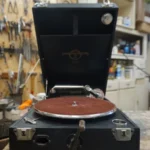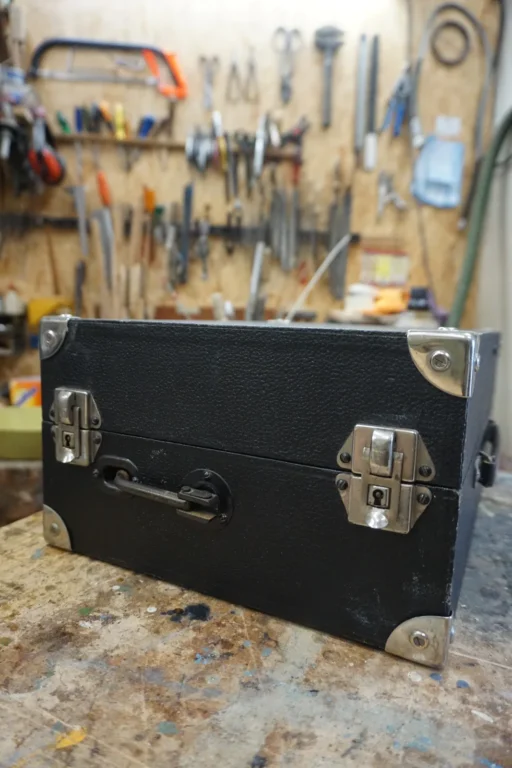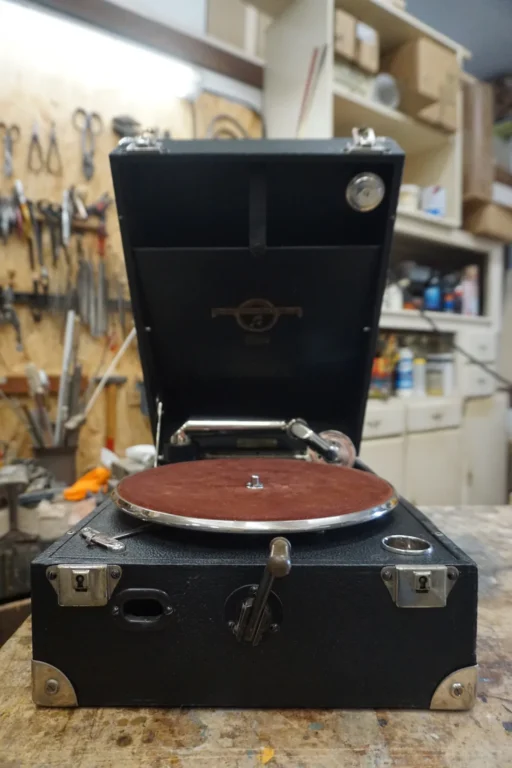
Some gramophones arrive on the workbench with an elegant, almost snobbish air, while others seem to say: “Look, I’m almost a hundred years old, I’ve seen things you humans wouldn’t believe… but right now I could use a helping hand.” Francesco’s Columbia Viva-Tonal Grafonola Model 109A definitely belongs to the second category: compact, clever, full of character and ready to sing again.
Meet the “Junior” with a Big Heart
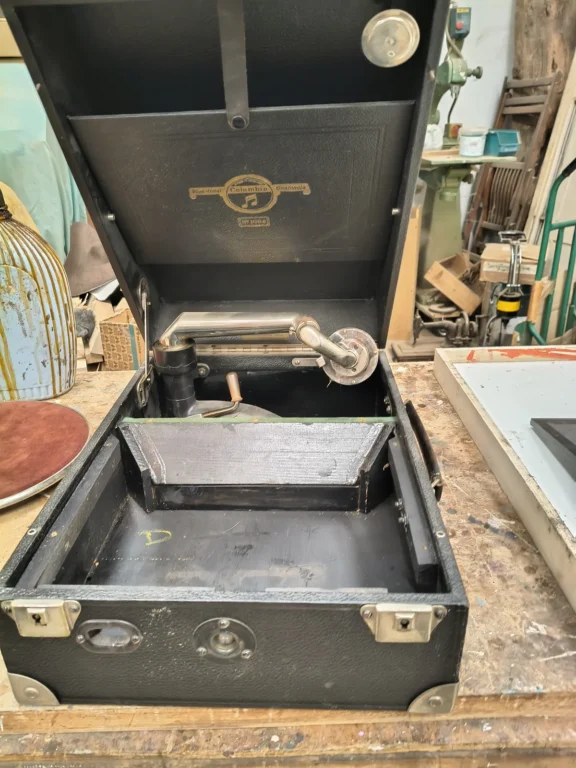
We’re talking about the late 1920s and early 1930s, in the heart of the Viva-Tonal era: the name Columbia gave to its new generation of electrically recorded discs and the equipment designed to play them. The 109A (often listed as the Junior Portable) was Columbia’s compact model: slimmer than many of its bulky counterparts, yet built around a very specific acoustic concept. Its distinctive Plano-Reflex tonearm, with its sharp angles, immediately makes it clear that this is no ordinary portable gramophone.
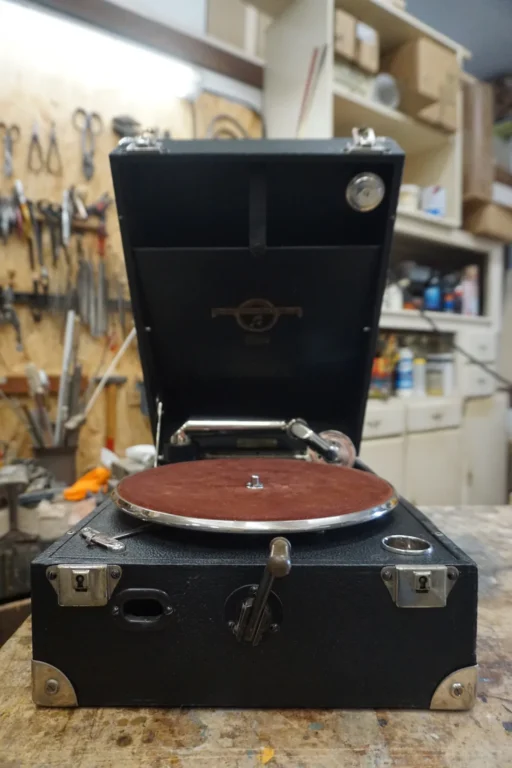
Inside the Columbia No. 109A on the workbench: the distinctive Plano-Reflex tonearm and the original decal inside the lid are clearly visible.
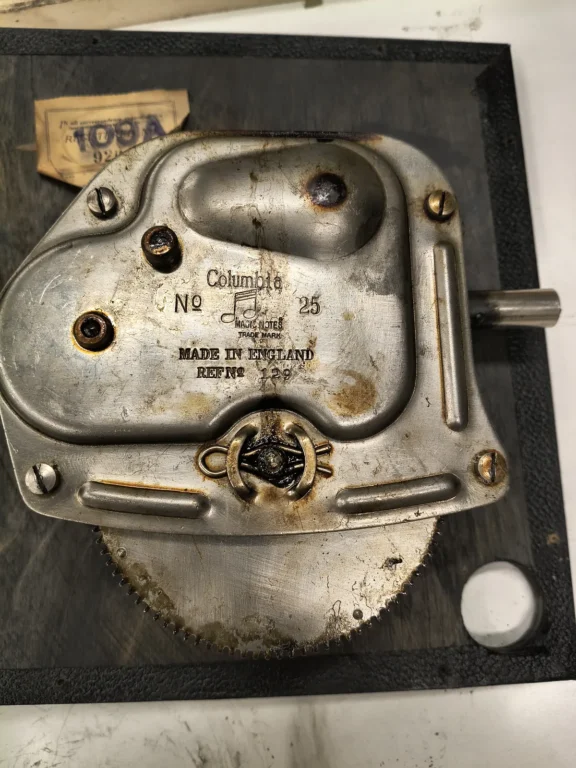
Under the turntable, powering the whole mechanism, is its Columbia No. 25 motor (Magic Notes, Made in England, Ref. No. 129), housed in a sealed, pressed-metal casing. A compact, ingenious mechanism, packed into a small space: perfect for making music, but not quite so convenient for anyone who enjoys easy access when it’s time to get their hands dirty.
The Columbia No. 25 motor (Ref. No. 129), viewed from underneath, alongside the original label stamped 109A.
What We Did (and Why Vintage Grease Is Never Your Friend)
Anyone who has ever opened a spring-driven motor knows that the line between “a quick lubrication” and “a mystical adventure through fossilised grease and springs steeped in history” is incredibly thin. In this case, the work was clear and focused:
-
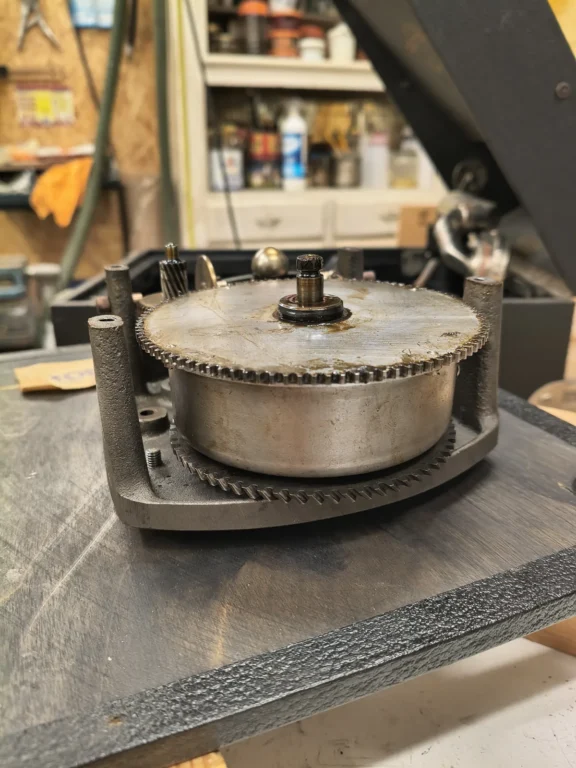
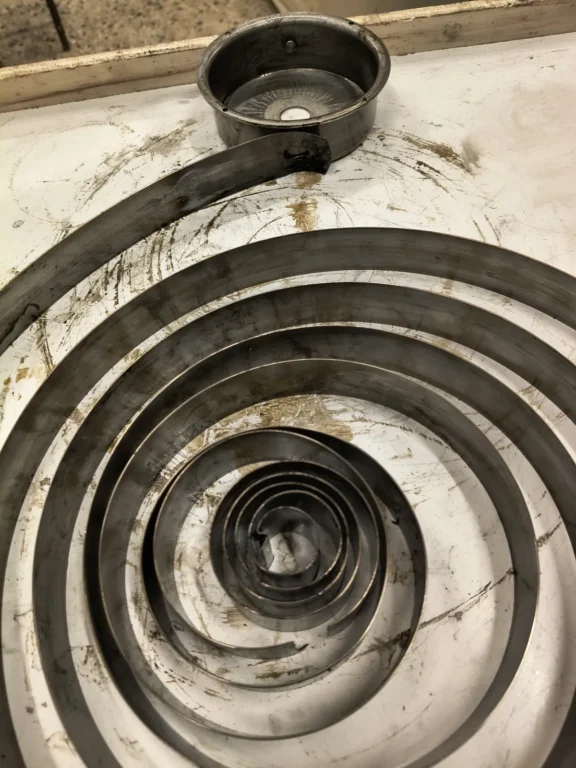
New mainspring: The original spring had broken who knows how long ago, leaving the motor in early retirement—as clearly shown in the photos below, with the spring barrel opened and the old spring removed from service. Fitting a new spring and properly lubricating it means restoring power and consistent performance, without any nasty surprises halfway through a record.
-
Motor cleaning and lubrication: Out with the dirt, hardened residue and old grease that had become more like glue than lubricant. In with the right lubricant, applied in the right places, so the gears and governor can work as they should.
-
Fine-tuning: Careful adjustments to ensure smooth, steady operation without hesitation.
-
Cleaning and polishing the nickel-plated parts: Because appearance matters too, and seeing the metal components shine again gives the whole gramophone a completely different look.
On the left, the motor’s spring barrel opened during servicing; on the right, the old mainspring, which had broken who knows when, removed and laid out on the workbench.