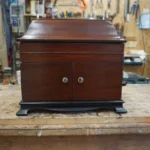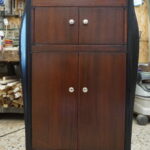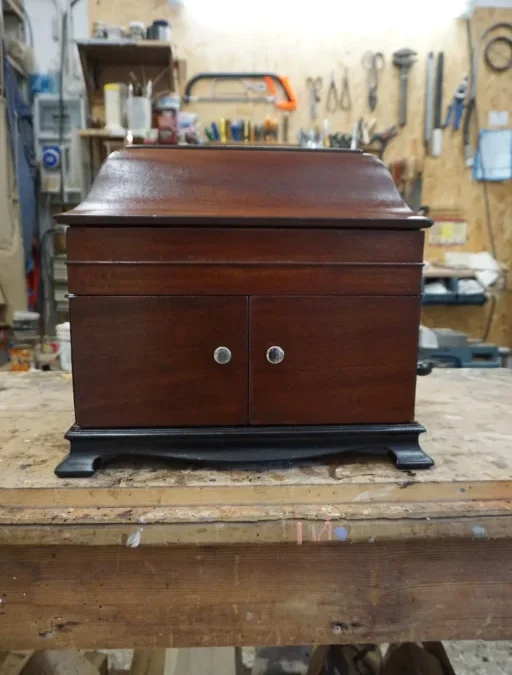
In our restoration workshop we have brought back to life a fundamental piece of sound reproduction history: an internal-horn phonograph, Victor Talking Machine Company model VV-IX, also known as the “Victrola the Ninth.” Introduced to the market in the summer of 1915, this tabletop gramophone represented, at the time, the centerpiece of the American middle-class living room, and was the fourth best-selling model in the history of the famous Camden, New Jersey company.
In this article we describe, step by step, the philological restoration carried out on this example: from the recovery of the wooden cabinet to the overhaul of the two-spring motor, through to the restoration of the original acoustic apparatus.
What is the Victrola VV-IX
The Victrola VV-IX is a tabletop gramophone produced starting in 1911 by the Victor Talking Machine Company, founded in 1901 by Eldridge R. Johnson and Emile Berliner. The model, sold at the time for 50 dollars (about 1,400 dollars today), was the first to popularize internal-horn technology, patented by Johnson to overcome the bulkiness of the external horns used in phonographs before 1906.
The name “Victrola” arose precisely from this innovation: the horn, folded downward, was concealed inside a wooden cabinet fitted with adjustable front doors for volume control.
Remaining in production for over 13 years, the VV-IX lived through World War I and Victor’s golden years, before the rise of radio and electrical recording in the mid-1920s brought about its end.
The condition of the piece before restoration
The example that arrived at the workshop showed the typical signs of age on a phonograph over a century old: a cabinet with weakened joints, degraded original finish, missing wooden feet, a motor jammed with hardened grease and graphite, and crystallized soundbox gaskets.
The restoration, step by step
1. Restoration of the wooden cabinet
Structural work: gluing to repair joint separations caused by time.
Stripping: removal of the old, degraded finish down to the original wood.
Rebuilding the feet: faithful replicas of the model’s original shapes for the missing parts.
Shellac finish: applied by hand-padding according to the historic period craft techniques.
2. Hardware and nickel-plated components
Disassembly, cleaning, and polishing of the original hinges, latches, and knobs.
Galvanic re-nickel-plating of parts with irreparably compromised plating.
3. Overhaul of the two-spring motor
Complete disassembly of gears, shafts, and spring barrels.
Thorough degreasing of hardened grease and graphite.
New high-viscosity lubrication for smooth, quiet winding.
Governor calibration and replacement of the brake felt to stabilize rotation at 78 rpm.
4. Restoration of the acoustic apparatus (soundbox and horn)
Replacement of the hardened soundbox gaskets, restoring elasticity to the mica diaphragm and eliminating metallic distortion.
Checking the acoustic seal of the cast-iron elbow and the internal wooden horn.
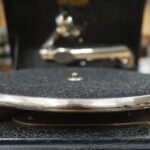
Replacement of the turntable felt with a philologically correct green felt, consistent with the year of manufacture.
The result of the restoration
Today this Victrola VV-IX plays again with the same clarity as the day it left the Camden factory. The motor turns silently, the wood tells its story beneath the shellac, and the mechanical voice of the past can be heard once more, with no electronic filters, exactly as it was over a century ago.
Frequently asked questions about the Victrola VV-IX
What year was the Victrola VV-IX made? The model was introduced in 1911 by the Victor Talking Machine Company of Camden, New Jersey, and remained in production for over 13 years.
How much did a Victrola VV-IX cost at the time? The list price was 50 dollars, equivalent to about 1,400 dollars today.
Why is it called “Victrola”? The name came from the innovation of hiding the acoustic horn inside a wooden cabinet, overcoming the bulkiness of the external horns of earlier models.
What does a philological restoration of an internal-horn gramophone involve? Structural recovery and refinishing of the cabinet, a complete overhaul of the spring motor and governor, restoration of the soundbox and the seal of the internal horn, and replacement of consumable materials (felts, gaskets) with philologically correct equivalents.
Can a restored Victrola gramophone still work? Yes: with an overhauled motor, calibrated governor, and regenerated soundbox, the machine plays 78 rpm records with full mechanical stability.